Content Does Not Fail at Writing. It Fails at Planning. Most content teams believe they have a writing problem. They do not. They have a decision problem.
Articles underperform not because sentences are weak, but because the wrong topics are chosen, intent is misread, and outlines are built on instinct rather than evidence.
Teams brainstorm ideas in meetings, pick something that sounds reasonable, open a document, and hope that SEO optimization or better phrasing will rescue performance later.
It almost never does. At scale, content failure is structural. Topic selection happens without understanding authority positioning. Competitor coverage is skimmed instead of modeled.
Outlines are gathered on recollection, previous achievement or templates. Decisions are already made before writing starts, and no amount of polish will fix the situation.
This is where AI tools for content research change the economics of content. Not because it writes faster. Because it reduces uncertainty before writing begins.
High-performing teams no longer treat content as a creative exercise supported by tools. They treat it as an operational system.
Research and planning become infrastructure. Writing becomes execution. The tools that matter most are not the ones that generate paragraphs, but the ones that answer three upstream questions with precision:
- Which topics are actually worth owning, given our authority and resources?
- What intent, concepts, and expectations must be addressed to compete credibly?
- How should this content be structured so it earns trust, rankings, and internal approval?
This article breaks down eight AI tools for content research and planning that operate at that level. These tools do not replace writers. They replace guesswork, rework, and strategic ambiguity.
What AI Tools for Content Research Actually Does
Before evaluating tools, the category itself needs to be defined correctly. AI tools for Content research is not keyword scraping.
- It is not a grammar correction.
- It is not bulk article generation.
Its role is upstream and strategic. Properly used, it supports four core planning functions.
Topic Discovery and Prioritization: Not “what can we write about,” but what should we write about, given authority, competition, and opportunity cost.
Intent and Audience Mapping: It is important to know what users are physically attempting to solve, decide, or evaluate when they search, not only the words they are searching with.
Structural Planning: Developing content architecture based on the way in which users consume information and the manner in which the modern search systems measure quality.
Gap and Angle Validation: Identifying what competitors cover thoroughly, what they ignore, and where differentiation is possible without inventing narratives.
Most teams misuse AI by applying it after writing starts. That improves speed, but not outcomes. Real leverage comes from applying intelligence before resources are committed.
This is also where blog outline AI becomes strategically important. Outlines are not formatted. They encode judgment. They decide emphasis, sequencing, evidence hierarchy, and omission. At scale, outlines become organizational memory. They standardize thinking while leaving room for creativity in execution.
With this lens, the following eight tools actually influence content strategy decisions rather than cosmetic output.
The 8 Best AI Tools for Content Research and Planning
MarketMuse
Category: Strategic Research and Topic Authority Planning
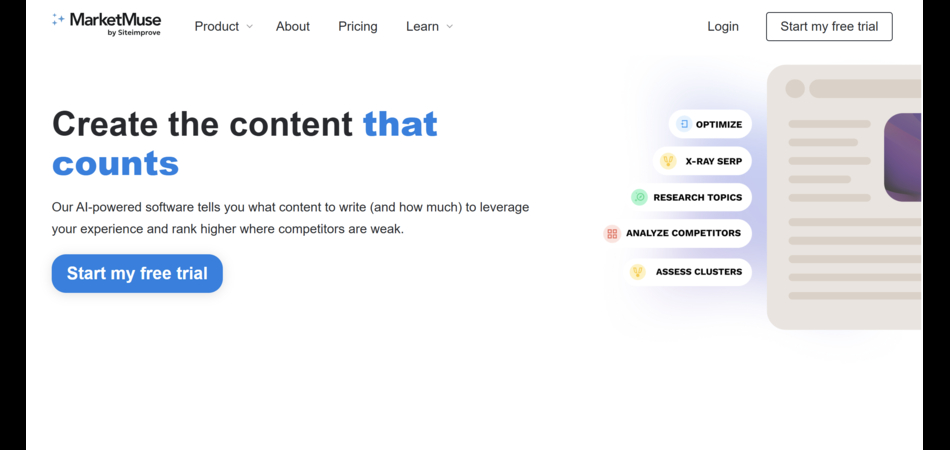
Strategic problem it solves: MarketMuse answers a question most teams avoid because it is uncomfortable: Which topics are we actually qualified to compete in right now?
How the AI works: It uses large-scale topic modeling to analyze your entire content inventory alongside competitors. Instead of keywords, it maps conceptual coverage, depth, and relationships across topic clusters, then scores your authority realistically.
Where it creates leverage: MarketMuse prevents wasted content investment. It aligns planning with achievable authority expansion instead of aspirational rankings. Over time, it shifts teams from chasing traffic to building defensible topical positions.
Limitations: It requires a meaningful content base. Startups with thin inventories will see limited insight early.
Best-fit teams: Mid-market and enterprise SaaS, agencies managing mature sites, editorial teams publishing at scale.
Pricing reality: High. Four figures per month and up.
Clearscope
Category: Semantic Research and Intent Mapping
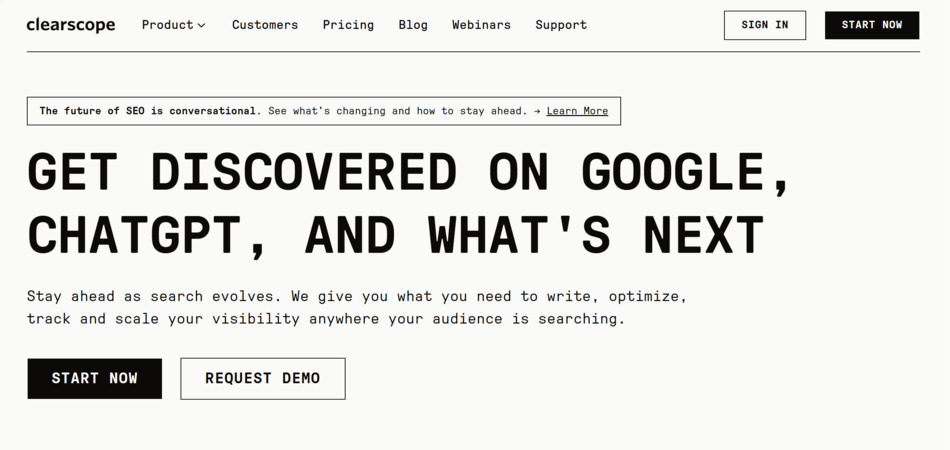
Strategic problem it solves: Clearscope answers: What does “complete” content look like for this topic?
How the AI works: Semantic modeling and vector similarity identify the concepts, entities, and explanations present across top-performing content. It focuses on meaning, not frequency.
Where it creates leverage: Clearscope prevents superficial depth. It ensures content satisfies conceptual expectations for both humans and AI-driven discovery systems.
Limitations: It does not discover topics. It refines them.
Best-fit teams: Teams prioritizing clarity, depth, and semantic credibility.
Pricing reality: Mid to high three figures per month.
Frase
Category: SERP Research and Competitive Outline Planning
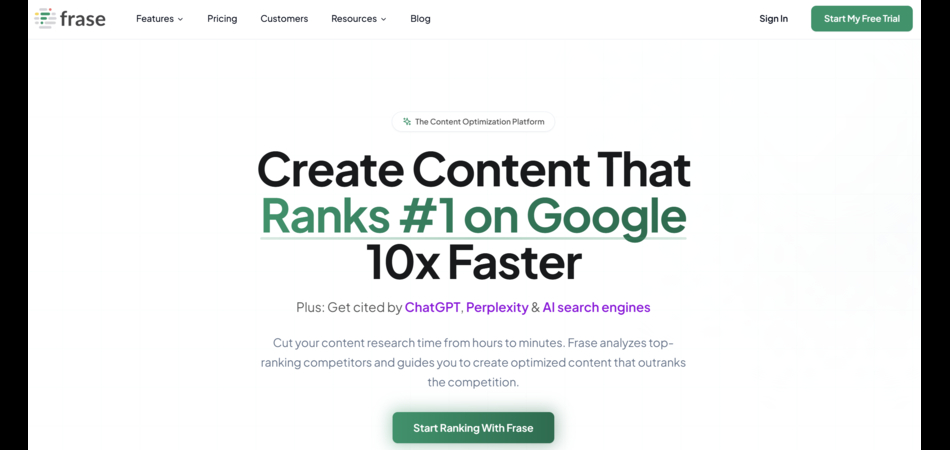
Strategic problem it solves: Frase answers: How are competitors structuring content that already works?
How the AI works: It analyzes ranking pages to extract structure, entities, questions, and discourse patterns, then organizes them into research inputs.
Where it creates leverage: It compresses hours of SERP analysis into minutes and grounds outlines in observable reality.
Limitations: It reflects current SERPs, which can bias planning toward existing patterns.
Best-fit teams: Agencies, content teams operating at speed, publishers tracking competitive shifts.
Pricing reality: Low to mid three figures.
Ahrefs Content Gap
Category: Competitive Intelligence and Gap Analysis
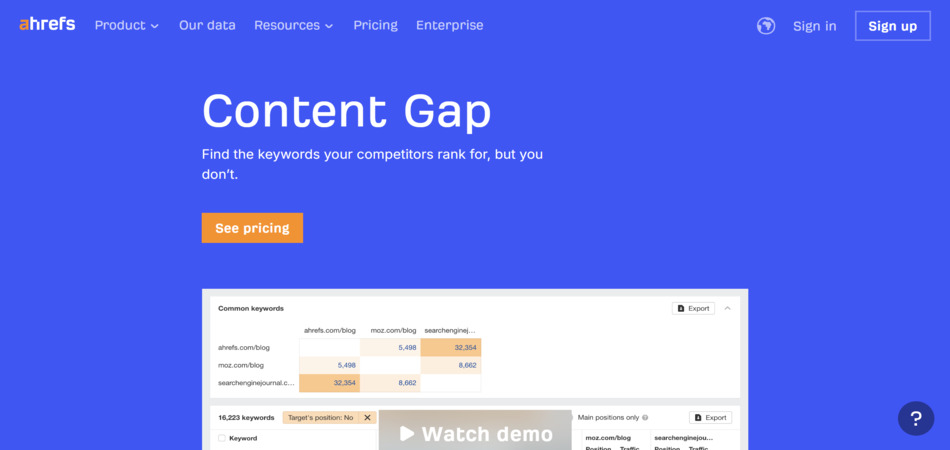
Strategic problem it solves: Ahrefs answers: Where are we absent, not just weak?
How the AI works: It compares keyword and topic intersections across domains and visualizes clusters to reveal coverage gaps and competitive dominance.
Where it creates leverage: It shifts planning from page-level tweaks to category-level strategy.
Limitations: Keyword-centric and requires human judgment for intent interpretation.
Best-fit teams: Enterprise strategy leads and agencies.
Pricing reality: Mid to high three figures monthly.
Semrush Topic Research

Category: Trend Discovery and Ideation
Strategic problem it solves: Semrush identifies: What topics are gaining momentum right now?
How the AI works: It analyzes search trend movement, clusters related questions, and surfaces popular angles and headlines.
Where it creates leverage: It accelerates editorial planning for timely, relevance-driven content.
Limitations: Trending bias can undervalue evergreen authority plays.
Best-fit teams: Media teams, SaaS blogs responding to evolving demand.
Pricing reality: Bundled within Semrush plans.
WRITER Blog Outline Agent
Category: Enterprise Outline Standardization
Strategic problem it solves: WRITER addresses approval friction: How do we create outlines that survive review without endless revision?
How the AI works: It learns from accepted and rejected outlines, encodes brand and stakeholder preferences, and adapts structure accordingly.
Where it creates leverage: It reduces review cycles and enforces consistency across distributed teams.
Limitations: Not a discovery or research engine.
Best-fit teams: Enterprise marketing organizations with complex governance.
Pricing reality: Enterprise contracts.
Jasper Blog Outline App
Category: Brand-Aligned Outline Planning
Strategic problem it solves: Jasper answers: How do we generate SEO-ready, on-brand outlines in one pass?
How the AI works: It combines topic input, brand voice, audience context, and structural logic through LLM-based planning.
Where it creates leverage: It accelerates planning while preserving brand discipline.
Limitations: It depends heavily on the quality of brand inputs.
Best-fit teams: In-house SaaS and product marketing teams.
Pricing reality: Mid three figures monthly.
Surfer SEO

Category: End-to-End Research, Planning, and Optimization
Strategic problem it solves: Surfer answers: How do we standardize research, planning, and optimization at scale?
How the AI works: It integrates SERP analysis, semantic correlation, and real-time scoring to guide structure and coverage.
Where it creates leverage: It reduces tool sprawl and enforces consistency across high-output teams.
Limitations: Correlation-based scoring can reward imitation over insight.
Best-fit teams: High-volume production teams and agencies.
Pricing reality: Mid three figures per month.
Comparison Table: Strategic Positioning at a Glance
|
Tool |
Primary Strategic Strength |
AI Depth |
Best For |
|
MarketMuse |
Topic authority modeling |
High |
Authority-first teams |
|
Clearscope |
Semantic completeness |
High |
Depth and clarity |
|
Frase |
SERP-based research |
High |
Fast competitive planning |
|
Ahrefs Content Gap |
Competitive mapping |
Medium |
Enterprise strategy |
|
Semrush Topic Research |
Trend discovery |
Medium |
Editorial calendars |
|
WRITER Outline Agent |
Approval consistency |
Medium–High |
Enterprise governance |
|
Jasper Outline App |
Brand-aligned outlining |
Medium–High |
In-house teams |
|
Surfer SEO |
Unified workflow |
High |
High-volume production |
How High-Performing Teams Combine These Tools
No single AI tool is sufficient for content strategy. Teams that attempt to force one platform to solve every problem usually end up with shallow outcomes and bloated workflows.
High-performing teams stack tools deliberately, with explicit role separation.
Research-First Editorial Teams
MarketMuse → Clearscope → Frase
This stack prioritizes authority over speed. MarketMuse defines strategic terrain. Clearscope ensures conceptual completeness. Frase validates structure against competitors.
Trade-off: High cost, slower throughput, minimal tolerance for experimentation.
Competitive, Gap-Driven Teams
Ahrefs Content Gap → Semrush Topic Research → Outline tool
This stack is defensive and opportunistic. It identifies where competitors win and where momentum exists.
Trade-off: Can become reactive if not balanced with authority planning.
High-Volume Production Teams
Surfer SEO as the core system
Unified workflows reduce coordination cost. Research, planning, and optimization occur in one environment, enabling scale.
Trade-off: Less strategic nuance per topic.
Enterprise, Stakeholder-Heavy Teams
MarketMuse → WRITER → Clearscope → Surfer
Each tool solves a governance constraint. Strategy, approval, semantic depth, and execution are separated but aligned.
Trade-off: Complexity, cost, and onboarding friction.
In all instances, the tendency has been the same. Not eight, two or three tools are used in mature teams. Over-stacking makes coordination cost rise at a quicker rate than output.
Choosing the Right Stack: A Practical Decision Framework
The selection of tools is not a matter of choice. It is about constraints.
Team Size and Velocity: Solo creators need simplicity. Large teams need systems. Velocity determines whether unified tools outperform modular stacks.
Strategic Goal: Authority or Volume: Authority-driven teams plan clusters and depth. Volume-driven teams optimize throughput. Mixing these goals produces diluted outcomes.
Approval and Governance: When multiple stakeholders review content, blog outline AI becomes critical. It standardizes expectations and reduces friction.
Data Maturity: Advanced tools amplify signal quality. Weak data breaks complex systems. Simpler tools often outperform early.
Budget Reality at Scale: Model costs at growth milestones. Cheap tools often penalize success. Measure cost per decision, not cost per seat.
Checklist:
- Clear authority goal
- Defined approval flow
- Clean data inputs
- Explicit tool ownership
Strategy decides tools. Tools do not decide strategy.
Final Thoughts: AI Tools for Content Research Is Strategy Enforcement
AI did not change the content because it learned how to write. It changed content because it learned how to evaluate decisions. This distinction matters more than any feature comparison.
Writing is visible. Planning is invisible. Writing feels productive. Planning feels slow. But outcomes do not compound from motion. They compound from direction.
Content research AI forces teams to confront reality early. It exposes authority limits, competitive pressure, and intent complexity before time and budget are spent.
It turns content planning from a creative guessing game into a disciplined decision process.
Blog outline: AI then operationalizes that discipline. It captures thinking rather than text. It ensures every writer begins from the same strategic foundation. Over time, outlines become institutional memory.
They preserve judgment as teams scale, hire, and rotate contributors. This is why many AI-driven content operations plateau. They automate execution without a stabilizing strategy.
They publish more, revise more, optimize more, and still struggle to see proportional impact. High-performing teams invert the sequence. They decide carefully, plan rigorously, and write efficiently.
From the outside, this looks uneventful. Fewer campaigns. Less urgency. More consistency. Internally, it feels controlled.
When research and planning become systems, content stops being fragile. It stops depending on individual brilliance or last-minute fixes. It becomes infrastructure.
And infrastructure compounds. If content matters to your business, treat upstream decisions with the same seriousness as output. Writing is execution. Strategy lives before the first word.