Most healthcare organizations already generate far more data than leadership teams could ever reasonably review. The real challenge is actually applying that data in a way that improves the decisions that healthcare leaders make every week: how schedules are built, where staffing gets added, which denials get prevented and what gets fixed first when performance slips.
Data analytics can help resolve uncertainty around those decisions while it’s still early enough to act on them. When used well, it supports earlier calls, fewer internal debates and fewer late surprises that force a scramble.
This article looks at where analytics can actually change outcomes in healthcare operations (and what has to be in place for leaders to rely on what it shows).
Using Data Analytics in Healthcare Is a Decision-Making Discipline
Data analytics is the process of collecting, cleaning, organizing and analyzing data to identify patterns, trends and useful information that can then be used to improve patient care, operations and financial performance.
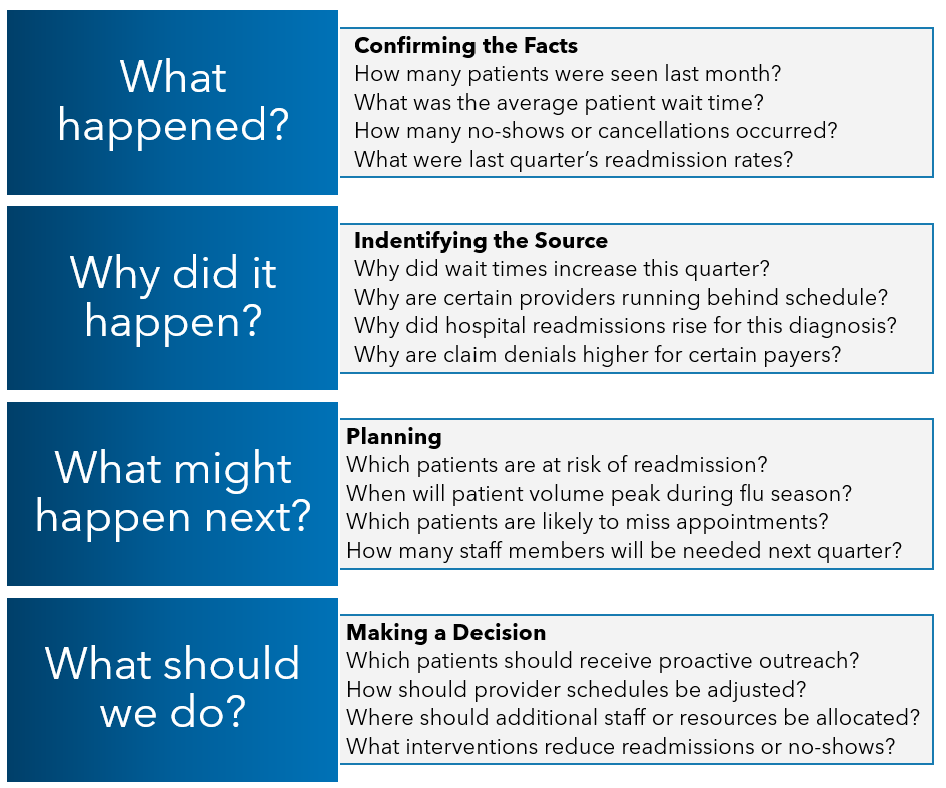
The goal of using data analytics is to move from reactive decisions to data-driven decisions. That happens by being able to answer these key questions in this order:
- What happened? (Confirming the facts)
- Why did it happen? (Identifying the source)
- What might happen next? (Planning)
- What should we do about it? (Making a decision)
Those questions may sound simple, but they solve a very real leadership problem. They keep teams from jumping from “something feels off” straight to solutions. They force the organization to confirm the baseline first, then isolate the cause, then look ahead and then choose an adjustment that should change the result.
Healthcare leaders really feel the data analytics difference when the fourth question can be answered clearly. That’s the moment that data stops being information and starts being management.
The Data Is Already There (Even if You Aren’t Using It)
Most healthcare organizations have a large amount of available data across systems that are already part of daily operations, and that can help answer these questions.
On the financial and administrative side, that often includes accounting software, practice management platforms, revenue cycle and clearinghouse tools, contracting and credentialing systems, HR and payroll, and supply chain, inventory and purchasing systems.
On the clinical and patient-care side, it includes the EMR or EHR, lab systems, imaging, e-prescribing systems, telehealth platforms and remote patient monitoring and wearables. Patient engagement and communication add another stream through portals, appointment reminders, review tools, satisfaction surveys, website analytics and phone system call data.
Compliance, risk and security data typically lives in HIPAA audit logs, access and security monitoring, incident reporting systems and compliance and credentialing trackers.
Obviously, healthcare organizations have no shortage of data. The key is knowing what data exists, how to retrieve it, how to read it consistently and what to do with it.
Without that knowledge, teams can have plenty of reports and still struggle to make confident calls because the numbers are incomplete, inconsistent or not comparable across functions.
The Main Types of Data Analytics Used in Healthcare
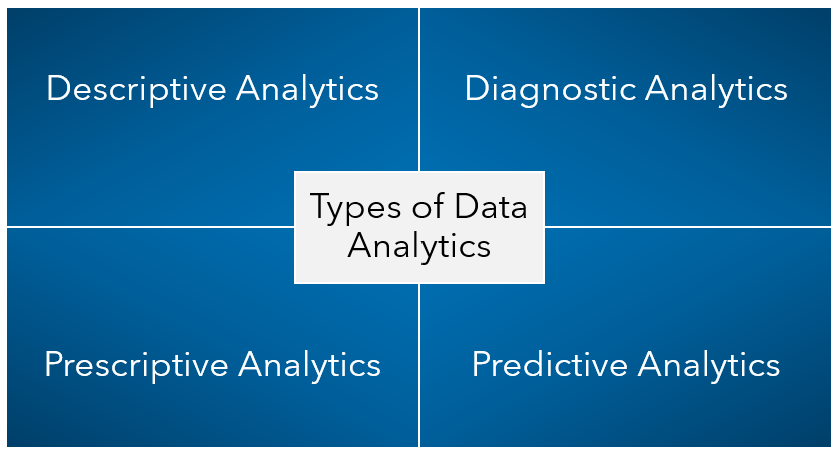
Healthcare organizations tend to use several types of data analytics that align to different leadership needs:
- Descriptive Analytics – Summarizes historical data to show what happened and identify trends, forming the baseline for other analysis.
- Diagnostic Analytics – Digs deeper to find the cause behind outcomes, uncovering factors contributing to specific health issues or operational problems.
- Predictive Analytics – Uses algorithms and machine learning on past data to forecast future events, such as predicting patients at high risk for readmission, chronic disease or potential outbreaks.
- Prescriptive Analytics – Goes beyond prediction to recommend specific actions, suggesting the best treatment path or resource allocation based on data-driven insights.
So, how do you know what type of data analytics could benefit your organization? You first have to be clear about the kind of answer you need.
A baseline trend won’t tell your organization what to fix; a diagnostic analysis will. A forecast supports planning and timing; a recommendation supports prioritization and execution. When those expectations are not clear, teams can produce reporting that is technically correct but does not move a decision forward.
What Has To Be True For Healthcare Leaders To Rely on Analytics
Strong analytics outcomes start with well-defined, consistent workflows across the practice. If processes break down at any point, including check-in, documentation, coding or billing, the data becomes unreliable.
Efficient use of EMR and practice management systems matters for the same reason. Analytics cannot compensate for incomplete documentation or inconsistent data entry. When data is not accurate and timely, leaders cannot rely on what they are seeing.
Analytics also requires cross-functional collaboration. It is not an IT-only or finance-only initiative. Finance, clinical and operational teams share responsibility for the workflows that produce the data and the governance that defines it.
Data quality and governance are essential because they ensure everyone is measuring the same thing in the same way. Without governance, different departments can report conflicting numbers, which undermines confidence and slows decision-making.
Compliance and security are also part of the foundation. Analytics should increase insight without increasing regulatory or privacy risk. Strong security and compliance frameworks allow data to be used confidently and responsibly.
When those elements are not in place, data analytics may highlight problems without supporting resolution. When they are in place, analytics becomes dependable enough to support decisions that affect staffing, scheduling, revenue cycle performance, cost control and compliance.
Learn More and Get Started With Data Analytics
Data analytics can make massive improvements for healthcare organizations when it shortens the distance between noticing a problem and acting on the driver behind it. When the right data is available, consistent and trusted, leadership can make decisions earlier, allocate resources with more confidence and reduce avoidable rework that shows up later as denials, delays and cost overruns.
To learn more about data analytics and how it can be used in your specific healthcare organization, contact your Warren Averett advisor directly, or ask a member of our team to reach out to you.

Back to Resources