AI is evolving faster than any organization could practically keep pace with, which is partially why many businesses treat it as a single entity (and often why businesses are disappointed with the results).
But if you want to get more from your AI investment, you have to first understand your AI tool and the technology behind it. Because different kinds of AI were made to accomplish different tasks, each kind comes with different pros, cons and considerations.
Here, we cover the four most common AI categories, so you see where it’s useful, when it makes the most sense to use it and what to be wary of.
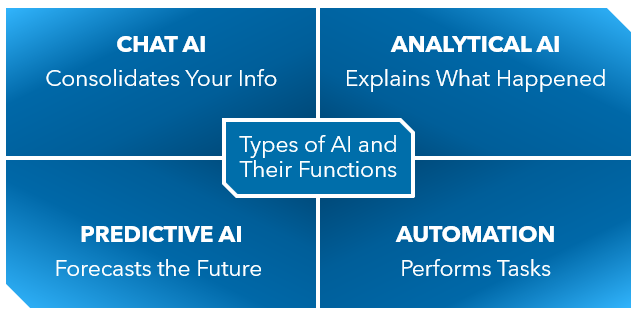
Chat AI: Consolidates Your Information
Where’s the vendor contract that you signed two years ago? How can you explain a new company-wide policy change to different departments? What are the most important takeaways from your last three-hour team meeting?
A business-focused chat that’s powered by AI can provide very specific internal information, so it’s easier to follow policies and consolidate information across nearly every conceivable device and platform. This is usually where businesses start if they’re just dipping their toes into AI waters.
However, chat AI is only as good as the information it’s given. As with public-facing tools, it can easily supply an answer that initially sounds good but quickly falls apart under any pushback. To use it effectively, you’ll need human experts across all administrative levels, and you’ll need to build in proper access controls and permissions to avoid security breaches.
Analytical AI: Explains What Happened
Why did your biggest market suddenly tank? Why does one platform run perfectly while another on the same server constantly glitches? Why does one department have higher employee turnover than another?
Analytical AI can identify trends and reveal insights into your business’s performance. The tools can crunch through massive amounts of data (both current and historical) to define what’s happening moment to moment.
Most companies use analytical AI to optimize financial reporting, customer relationships and operational logistics or to explain inconsistencies that already exist across departments and systems. It works best for businesses that have well-defined goals, strong analytical metrics and excellent human oversight.
Analytical AI often demands your company’s most sensitive data (e.g., financial reports, sales patterns, employee sentiment surveys, etc.) across systems. In addition, many companies find that it takes more time and effort than they anticipate before it generates useful insights.
Predictive AI: Forecasts the Future
When will you start to see consumer patterns shift? Can you count on your supply chain to withstand a major global disruption? How much will your company’s reputation affect future sales? Will you be able to afford a new database system a year from now?
Predictive AI relies on historical patterns to form educated guesses about the future. It’s similar to analytical AI, but it moves past standard analysis into speculation. Even more so than analytical AI, your data needs to be as thorough and accurate as possible to yield usable results.
No matter how sophisticated a predictive AI system is, though, companies will still need to regularly test and adjust their strategies as time goes by. Forecast accuracy is usually best for companies with stable leadership and goals because it helps them manage risks and improve financial performance.
We all know the world is unpredictable. Regardless of how much historical data we have, predictions are an exercise in probability at absolute best. In addition, if you’re constantly acquiring new companies, shifting markets and debuting new products at random, your forecasts will be less dependable because the AI program won’t be able to sense a clear pattern.
Automation: Performs Tasks
How much time are you spending on customer support workflows? Document management? Service tickets? Employee onboarding? Invoice processing? How do employees and customers feel when there are multiple delays or inaccuracies?
AI automation has become far more advanced in recent years. Companies can set rules, monitor decision points and let it run from there to perform tasks. Employees have more time to apply their creativity and expertise to their department’s bigger picture projects.
Automation is usually recommended for companies with very specific workflows. You’ll need experts to determine both what decisions to automate and how to monitor the automation as time goes by. Start with relatively narrow, routine tasks before branching out (e.g., researching sales prospects and defining their biggest pain points).
The process must be well-defined before automation, or else you’ll inadvertently increase the scope of any existing inconsistencies or issues. Automation also typically requires full-scale integrations of your applications, databases and communication platforms, which can introduce serious complications to your network.
What Every AI Initiative Needs To Succeed
While each AI category and tool is different, they do all have a few things in common that they need for your company’s investment to be successful.
- Accurate, Comprehensive Information – If your information is poorly maintained, you can’t expect anyof your AI tools to work properly. Preparing your data may take a lot of work and time, but it’s the only way to get any value out of your investment.
- Well-Defined Ownership – AI needs a strong level of oversight, no matter which tool you end up working with. Someone needs to be accountable for output quality, maintenance and access controls.
- Realistic Expectations – Leadership often expects AI to do complex work without fully understanding how it arrives at its conclusions or advice. If your expectations aren’t defined or they’re too grandiose, you won’t be able to measure the results.
Learn More About Using AI Effectively in Your Business
AI can do a lot, but it can only work with the information it has. Organizations need to consider what they want, what data they’re willing to share to get it and how they want that data used before they select and implement the right tool for them.
To learn more, contact your Warren Averett advisor directly, or ask a member of Warren Averett Technology Group to contact you to get the conversation started.

Back to Resources