Email did not fail. The logic behind it did. Most teams scale email lists without scaling intelligence. The pattern is predictable. A list grows from 5,000 to 50,000 subscribers, but segmentation rules stay frozen.
“Purchased in the last 30 days.” “Opened three emails.” “Clicked once.” At low volume, those rules feel precise. At scale, they turn blunt.
High-value repeat buyers receive the same discount blasts as one-time purchasers. Cart abandonment emails fire at 3 a.m.
Re-engagement campaigns target people who are still active, while real churn risk stays invisible. Revenue per email declines slowly enough that teams justify it as normal.
Someone eventually says, “We should try AI.” That instinct is right. The expectation is wrong. Most teams expect AI email marketing tools to improve copy. Better subject lines. Faster writing. Slightly higher open rates.
Those gains are marginal. They do not fix bad timing, weak targeting, or irrelevant sequencing. Traditional automation treats email as a calendar problem. Modern AI email marketing tools treat email as a decision problem.
That distinction decides outcomes at scale. Customer behavior is non-linear. Intent spikes briefly, then vanishes. Purchase cycles compress, then stretch. Some customers need reminders. Others need restraint.
Static rules cannot adapt, no matter how complex the flowchart becomes. The tools that outperform in 2026 share one trait. They predict what is likely to happen next and act without waiting for human intervention.
This shift from scheduling to prediction is the real leap in automation. This guide analyzes seven AI email marketing tools that actually operate at that level.
Not what their landing pages promise, but how they behave in production, where they create leverage, where friction appears, and what it costs to scale responsibly.
What qualifies as real AI email marketing in 2026
The market is crowded with platforms that label basic features as AI. Most are cosmetic. Real AI email marketing tools are not about writing faster emails.
They are about making better decisions automatically, at a speed and volume humans cannot match.
Three characteristics separate real systems from surface-level automation.
Continuous learning from live data
The system updates its logic as new behavior arrives. Opens, clicks, purchases, refunds, page visits, CRM changes. Not quarterly retraining. Not frozen cohorts.
When behavior shifts, the model adapts. Seasonality changes buying frequency. Engagement decays or rebounds. The system recalculates without manual resets.
Probabilistic decision-making
Insight alone does not move revenue. Execution does. Real AI email marketing tools build segments dynamically, choose send times per individual, route leads to sales or nurture, and trigger sequences without requiring approval every time.
Humans define constraints. The system operates inside them. If a tool only suggests copy or recommends a single send time for an entire list, it is productivity software.
Useful, but not AI-driven automation. The tools below meet this bar to different degrees. Those differences determine who should use them and who should not.
Autonomous execution inside workflows
Insight alone does not move revenue. The system must act. That means building segments dynamically, choosing send times individually, routing leads to sales or nurture, and triggering sequences without manual approval each time.
Humans define intent and constraints. The system executes within those boundaries. If a tool only generates a copy or suggests a single send time for an entire list, it is productivity software.
Useful, yes. But it is not AI email marketing. The tools below meet this bar to different degrees. Some push autonomy aggressively. Others emphasize guidance and optimization.
Those differences define who should use them and who should not.
Tools Breakdown
1. Klaviyo
Best for: Data-heavy eCommerce brands that optimize for repeat purchase
Platform snapshot
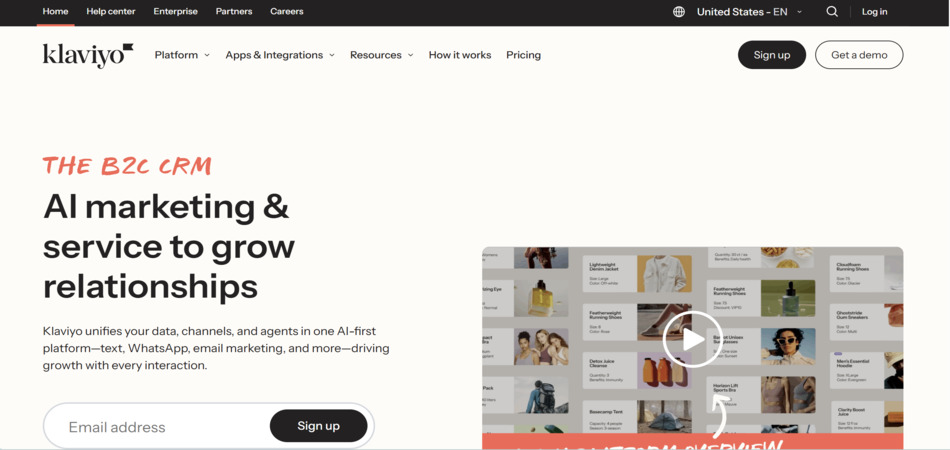
Klaviyo is fundamentally a customer data engine. Email is just the output layer. Unlike general-purpose platforms, Klaviyo is built around real-time commerce events.
Every product view, cart action, purchase, refund, and subscription update feeds directly into its decision logic. That architecture is why it dominates eCommerce use cases in 2026.
Where AI actually drives results
Klaviyo’s AI matters in timing and targeting, not writing.
- Predictive analytics: CLV, churn risk, and next order date are calculated per contact and update continuously.
- Natural-language segmentation: You describe intent, not logic. The system builds the conditions.K:AI
- Marketing Agents: Goal-based agents that assemble entire flows based on revenue objectives, not templates.
This replaces static “30-day” automations with behavior-aware triggers.
Best-fit scenarios
- DTC brands with repeat purchase cycles
- Subscription commerce
- Stores with rich behavioral data
Where it breaks
- B2B or low-frequency purchase models
- Teams without clean event tracking
- Large lists with weak engagement hygiene
Pricing reality
- Free up to ~250 contacts
- ~$20/month at 500 contacts
- Becomes expensive fast at scale if engagement drops
2. ActiveCampaign
Best for: B2B, SaaS, and there are long consideration funnels.
Platform snapshot
ActiveCampaign is built for decision trees, not broadcasts. It assumes you want automation to decide who gets attention and when, not just what message goes out.
Where AI actually drives results
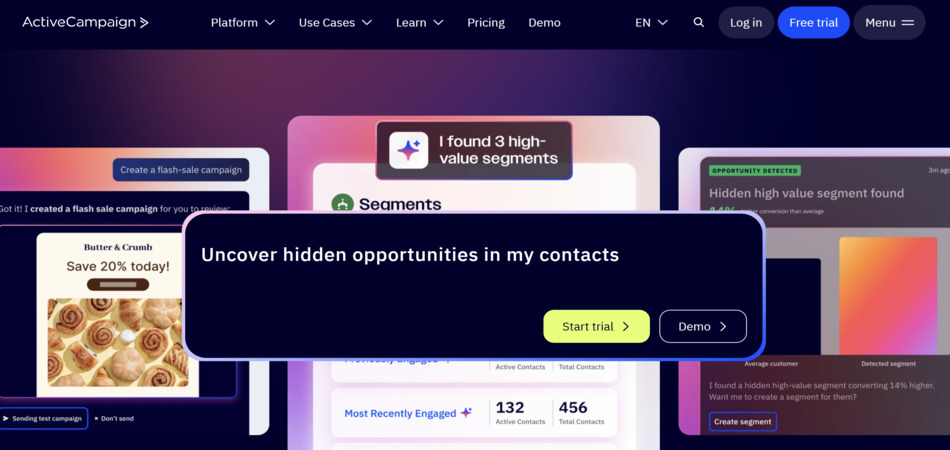
- Win Probability: Predicts likelihood of deal close using CRM + engagement data
- Predictive Sending: Emails land when each individual typically opens
- AI Campaign Builder: Generates multi-step workflows from intent prompts
The value is in routing logic, not content creation.
Best-fit scenarios
- SaaS with sales qualification
- Consulting or education funnels
- Businesses where human sales time is scarce
Where it breaks
- Beginners or non-technical teams
- Organizations without automation governance
- Teams that want plug-and-play simplicity
Pricing reality
- Starter (~$15/month) lacks AI depth
- Plus (~$59/month) is required for predictive features
- Complexity cost grows faster than contact cost
3. HubSpot Marketing Hub
Best for: CRM-first B2B teams and account-based marketing.
Platform snapshot
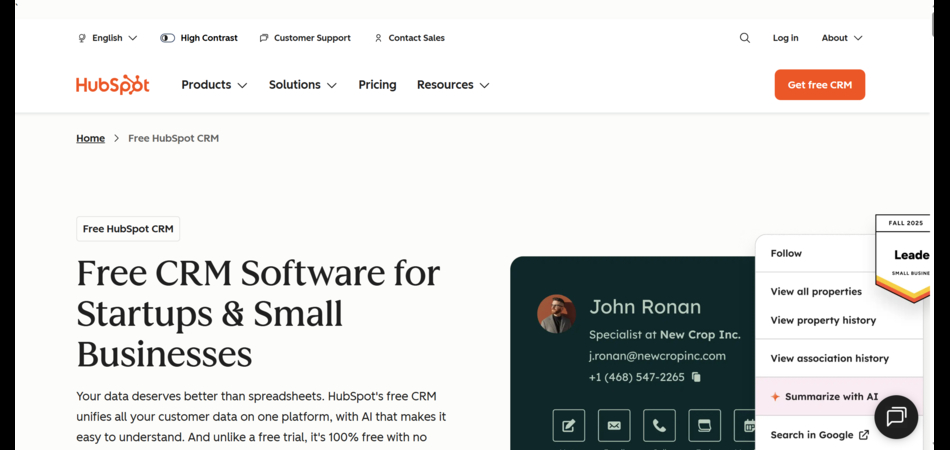
HubSpot’s strength is context density. Automation of emails is based on sales activity, history of CRM, support tails, and on-site behavior. It is the visibility of cross-functionality and the true differentiator.
Where AI actually drives results
- Breeze Intelligence: Buyer intent detection based on page-level behavior
- Smart Send Times: Optimized using enterprise-scale engagement data
- Breeze Agents: Semi-autonomous workflows tied to CRM signals
Email actions reflect relationship state, not just inbox activity.
Best-fit scenarios
- Mid-market and enterprise B2B
- Account-based marketing
- Teams aligning marketing and sales workflows
Where it breaks
- Small teams with limited budgets
- Simple funnels
- Anyone not committed to HubSpot’s ecosystem
Pricing reality
- Starter: ~$15–$20/seat (limited automation)
- Professional: ~$890/month (real AI access)
- Credits introduce variable costs
4. Omnisend
Best for: SMB eCommerce teams that want speed over depth
Platform snapshot
Omnisend is opinionated by design. It deliberately limits complexity so small teams can execute without overengineering.
Where AI actually drives results
- Plain-English segmentation: Fast audience building
- Product recommendations: Behavior-based inserts without manual rules
- Lifecycle Map: Auto-classifies contacts into revenue-relevant stages
This is guided automation, not autonomous decisioning.
Best-fit scenarios
- Shopify and WooCommerce stores
- Lean marketing teams
- Brands under ~$5M revenue
Where it breaks
- Advanced experimentation
- B2B or content businesses
- Teams needing granular control
Pricing reality
- Free tier available
- Pro starts around ~$59/month
- Strong ROI before Klaviyo-level scale
5. Brevo
Best for: High-volume senders and budget-sensitive teams
Platform snapshot
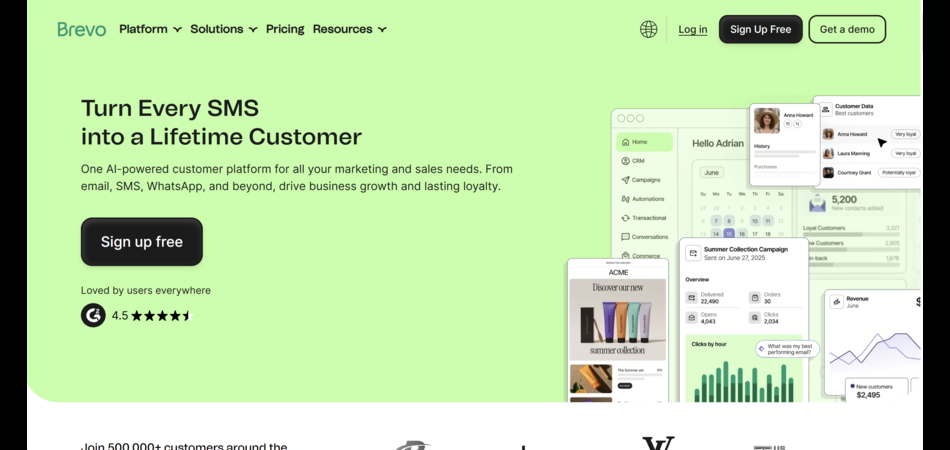
Brevo prioritizes cost efficiency over sophistication. It trades depth for scale affordability.
Where AI actually drives results
- Send Time Optimization: Individual-level timing
- AI copy assistance: Functional, not advanced
- Product recommendations: Basic personalization
The intelligence layer focuses on delivery optimization.
Best-fit scenarios
- Media newsletters
- Large contact databases
- SMBs with tight budgets
Where it breaks
- Complex lifecycle automation
- Deep attribution analysis
- Advanced segmentation logic
Pricing reality
- Free with daily caps
- Business tier (~$65/month) unlocks AI
- One of the cheapest tools at scale
6. Mailchimp
Best for: Generalist teams and local businesses
Platform snapshot
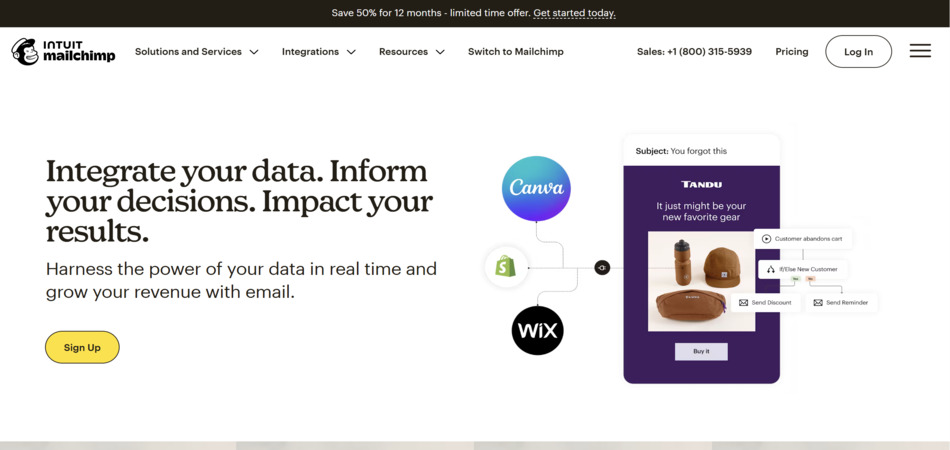
Mailchimp optimizes for approachability. It reduces friction for teams without dedicated lifecycle marketers.
Where AI actually drives results
- Intuit Assist: Email drafts, tone shifts, layout generation
- Predictive demographics: Infers age and gender
- Journey suggestions: Basic next-step recommendations
This is assistive AI, not autonomous automation.
Best-fit scenarios
- Local services
- Early-stage startups
- Non-specialist teams
Where it breaks
- Advanced eCommerce
- Sales-led B2B
- Long-term cost efficiency
Pricing reality
- Standard (~$20/month) required for AI
- Feature fragmentation across tiers
- Price creep over time
7. GetResponse
Best for: Solopreneurs who want speed, not systems
Platform snapshot
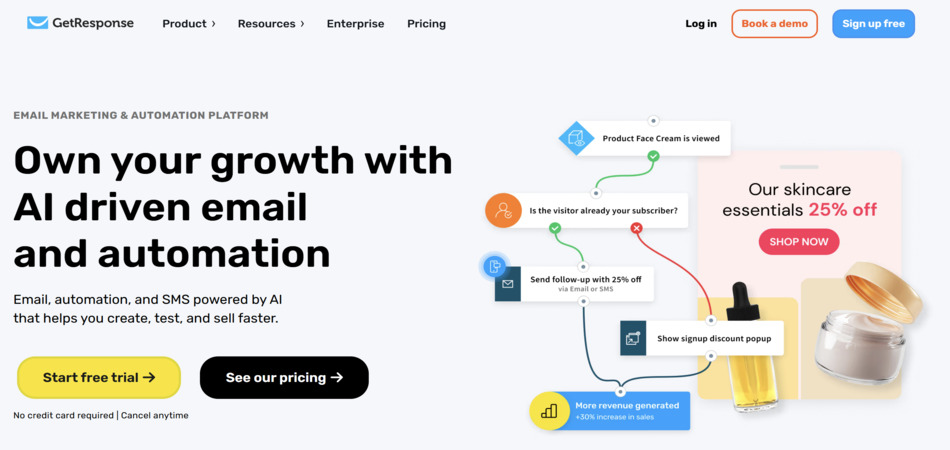
GetResponse emphasizes done-for-you creation. It minimizes planning and setup time.
Where AI actually drives results
- AI Email Generator: Full email creation from prompts
- Autoresponder Generator: Auto-built sequences
- Web push timing: Simple cross-channel coordination
Creation is the focus. Strategy is assumed, not enforced.
Best-fit scenarios
- Coaches and creators
- Solo operators
- Launch-driven businesses
Where it breaks
- Predictive lifecycle automation
- Complex segmentation
- Scaled retention strategies
Pricing reality
- ~$19/month for AI email creation
- ~$59/month for automation
- Limited upside at scale
Comparison table
|
Tool |
Core Strength |
AI Depth |
Best For |
Cost at Scale |
|
Klaviyo |
Predictive commerce |
High |
DTC, subscriptions |
High |
|
ActiveCampaign |
Lifecycle logic |
High |
B2B, SaaS |
Medium |
|
HubSpot |
CRM-driven context |
High |
Enterprise B2B |
Very high |
|
Omnisend |
Ease of use |
Medium |
SMB eCommerce |
Medium |
|
Brevo |
Cost efficiency |
Medium |
High-volume senders |
Low |
|
Mailchimp |
Accessibility |
Low |
Small teams |
Medium |
|
GetResponse |
Speed of creation |
Low |
Solopreneurs |
Medium |
Decision framework: how to choose the right tool by business type
Choosing among AI email marketing tools is not a feature comparison. It is a systems decision.
Most teams ask, “Which tool is best?” That question is useless in practice. The right question is, “Which tool fails least for how my business actually operates?”
To answer that, evaluate three dimensions honestly: revenue mechanics, data maturity, and tolerance for automation autonomy.
Start with how revenue is generated
Email sits downstream of your business model. If the platform optimizes for the wrong revenue mechanics, its intelligence compounds in the wrong direction.
- Transactional, repeat-driven revenue: Predictive commerce systems outperform. Platforms like Klaviyo or Omnisend work because they observe dense behavioral signals early, including browsing, purchase cycles, and churn risk. AI can act before revenue drops.
- Sales-led, probabilistic revenue: Lifecycle automation matters more than volume. ActiveCampaign and HubSpot perform better because they score intent, estimate close probability, and decide when humans should intervene. In these models, timing a sales handoff beats marginal open-rate gains.
- Content or volume-driven revenue: Scale efficiency dominates. Brevo excels here because individual send-time optimization across large lists delivers incremental gains without driving up cost.
Mismatch risk: When the platform and revenue model do not align, intelligence idles while operational drag increases.
Be realistic about data quality
AI does not repair weak data. It amplifies it. Advanced platforms assume accurate event tracking, clear lifecycle stages, and current CRM data. When those inputs degrade, predictive models drift.
Teams with immature data often perform better on simpler systems. Omnisend, Brevo, or Mailchimp rely on fewer signals and stronger defaults, which produces more consistent outcomes early.
This is not a permanent choice. It is sequencing. Clean the data first. Then introduce deeper automation. Skipping that step creates expensive systems that look advanced but behave unpredictably.
Decide how much autonomy your team can handle
Automation is cultural, not just technical. Some teams want AI to suggest actions. Others want it to execute. Those models require very different levels of trust and governance.
Agent-driven systems like Klaviyo assume comfort with models triggering campaigns and adjusting timing with minimal oversight. That delivers speed, but only if ownership is clear.
Guided systems like Omnisend or Mailchimp reduce risk by constraining decisions. You trade flexibility for predictability. Failure mode: Adopting more autonomy than the team can manage turns automation into chaos.
Model cost at scale, not at signup
Entry pricing is misleading. Most tools are affordable at low volume. Few remain efficient at scale. Model cost at 10k, 50k, and 100k contacts. Account for engagement decay, required tiers, seats, and usage-based credits.
A tool that looks expensive early may stabilize at scale. A tool that looks cheap initially may quietly punish growth.
Choose for today, with an exit path
No email platform is permanent. Early-stage teams should optimize for speed and learning. Growth-stage teams need control and predictability.
Scale-stage teams require cross-functional alignment and governance. The right choice is rarely the most powerful tool. It is the tool that fits current constraints without locking you into the wrong future.
Final thoughts: AI email marketing tools are systems, not a feature
AI email marketing does not generate revenue by itself. It generates leverage.
Leverage only compounds when the underlying system is sound. A weak strategy scaled by automation produces weak results faster. Clear lifecycle logic scaled by intelligence compounds quietly.
Teams winning with AI email marketing tools understand their mechanics. They know which behaviors matter, when to act, and when to stay passive. AI executes those decisions at a speed humans cannot match.
Effective automation looks boring from the outside. Fewer campaigns. Better timing. Less manual oversight. Email stops being a channel you control and becomes infrastructure your business depends on.
Define the system first. Automate second. Scale only what already works.
Everything else is feature shopping.